
Radar
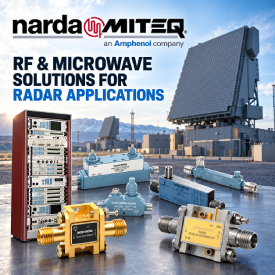
Modern radar systems depend on advanced RF and microwave technology to detect, track, and monitor objects across increasingly complex environments. Narda-MITEQ supports radar applications with high-performance amplifiers, phase shifters, frequency conversion components, signal routing products, and custom integrated microwave assemblies. From active electronically scanned array (AESA) radar to conventional phased-array and precision tracking systems, our RF and microwave technologies provide essential building blocks for sophisticated radar sensor architectures.
With decades of experience developing components and subsystems for commercial, aerospace, and military applications, Narda-MITEQ offers both standard products and custom-engineered solutions for demanding radar applications. Our capabilities include RF and microwave components, receiver assemblies, and integrated microwave assemblies designed around specific electrical, mechanical, and environmental requirements.
Active Radar Sensor Systems and Classifications
Radar is an active sensing technology that transmits electromagnetic signals and analyzes their reflections to determine information about objects, including range, velocity, direction, and movement. Unlike passive sensing systems, which detect existing electromagnetic emissions, active radar generates its own signals to observe the surrounding environment.
Modern active radar sensors can be classified according to their antenna architecture, scanning method, waveform, and operational purpose. Common applications include surveillance and search radar, target tracking radar, pulse-Doppler radar, synthetic aperture radar (SAR), and multifunction radar systems.
A key architectural distinction is how radar beams are directed. Mechanically scanned radar physically moves an antenna, while electronically scanned arrays use controlled signal relationships across multiple antenna elements to steer beams without requiring equivalent mechanical movement. These electronically steered systems include passive electronically scanned arrays (PESA) and active electronically scanned arrays (AESA).
Narda-MITEQ supports these radar architectures through a broad selection of RF and microwave amplifiers, phase shifters, power dividers, PIN diode switches, and custom subsystem integration capabilities.
AESA and Phased-Array Radar Technology
Active electronically scanned array (AESA) radar is an advanced form of phased-array radar that uses distributed active transmit and receive circuitry across the antenna array. This architecture supports electronic beam steering, flexible radar operation, and the ability to manage multiple radar functions through sophisticated electronic control.
Passive electronically scanned array (PESA) radar generally uses a shared RF source with a controlled distribution network, while AESA architectures distribute active RF functions among antenna elements or groups of elements. Depending on the system design, phased-array radar architectures can incorporate amplification, phase control, amplitude control, signal distribution, frequency conversion, and receiver protection.
Narda-MITEQ offers many of the RF and microwave component technologies used to implement these functions. Our analog and digital phase shifters, PIN diode attenuators, power dividers, and RF switches provide engineers with options for developing controlled signal paths and beamforming-related RF networks.
For applications requiring multiple functions within compact packages, Narda-MITEQ's integrated microwave assemblies offer a path toward custom subsystem designs suited to demanding phased-array radar requirements.
Low Noise Amplifiers and Radar Receiver Sensitivity
Receiver sensitivity is an important consideration in radar design, particularly when detecting weak signals reflected from distant objects. Low noise amplification helps preserve signal quality by increasing received signal levels while minimizing additional noise introduced by the receiver electronics.
Narda-MITEQ's low noise amplifiers (LNAs) cover RF, microwave, and millimeter-wave applications from 1 kHz to 67 GHz. Our portfolio includes narrowband, wideband, and ultra-low-noise solutions that can support radar receiver front ends, surveillance systems, and other demanding sensor applications.
Protecting sensitive receiver components is also an important requirement in radar systems exposed to high-power RF signals. Narda-MITEQ offers PIN diode limiters designed for receiver protection, including applications requiring fast recovery and resistance to high-power pulses.
Together, low noise amplifiers and receiver protection components help engineers address signal sensitivity and input protection requirements in complex radar receiver architectures.
Beam Steering, Phase Control, and RF Signal Distribution
Electronically scanned radar systems depend on accurate control of signal amplitude, phase, and distribution. These functions help establish the required relationships between antenna elements and support electronically controlled radar beam patterns.
Narda-MITEQ designs and manufactures solid-state phase shifters for demanding radar, telemetry, space, and electronic warfare applications. Our phase shifter technologies include analog and digitally controlled solutions designed to provide dependable phase adjustment across a range of operating conditions.
Additional signal control capabilities include RF power dividers for distributing signals, PIN diode attenuators for controlled attenuation, and PIN diode switches for selecting and routing RF paths.
By combining these component technologies, engineers can develop RF distribution and control networks for phased-array radar, radar receivers, and related sensor systems.
Radar Frequency Generation and Conversion
Radar architectures also require stable frequency sources and reliable frequency conversion to support RF signal generation, reception, and processing. Frequency stability, phase noise, conversion performance, and signal purity can all influence radar subsystem performance.
Narda-MITEQ offers frequency synthesizers and oscillators for applications requiring controlled microwave frequency generation. Our synthesizer technologies include phase-locked-loop designs developed for frequency stability and application-specific performance requirements.
For frequency translation, Narda-MITEQ provides RF and microwave mixers supporting a broad range of conversion applications. These products can be combined with amplifiers, frequency sources, and other signal-processing components to develop receiver and conversion chains for radar applications.
Custom converter assemblies and receiver assemblies provide additional options for engineers who require multiple RF functions integrated into application-specific subsystems.
Custom Receiver Assemblies and Phased-Array Radar Subsystems
Advanced radar projects often require more than standard catalog components. Custom RF and microwave assemblies can combine multiple functions into compact packages while addressing demanding interface, electrical performance, and mechanical integration requirements.
Narda-MITEQ's RF and microwave assembly capabilities include experience with phased-array radar subsystems, monopulse receivers, synthetic aperture radar (SAR) exciter and receiver systems, multichannel receiver front ends, and RF signal distribution subsystems.
Our receiver assemblies support customized approaches to signal reception and processing, while integrated microwave assemblies (IMAs) bring multiple RF and microwave functions together within engineered subsystem configurations.
This approach can help system integrators reduce interconnection complexity, improve packaging efficiency, and simplify the integration of specialized RF functions into larger radar platforms.
Radar Applications Across Air, Land, and Sea
Radar technologies support a wide variety of applications across military, aerospace, commercial, and industrial environments. These include ground-based surveillance, airborne radar, naval radar, weather monitoring, air traffic surveillance, synthetic aperture radar imaging, and precision tracking systems.
In defense applications, radar sensors play an important role in surveillance, situational awareness, and early warning. AESA and phased-array architectures are especially relevant to advanced platforms requiring electronic beam steering and flexible radar operation.
Narda-MITEQ supports radar system developers with RF and microwave technologies that can be incorporated into these applications. Customers can explore our broader military RF and microwave solutions or select individual components and assemblies based on their radar architecture and performance requirements.
Why Choose Narda-MITEQ for Radar Applications?
Narda-MITEQ brings more than 70 years of RF and microwave industry experience to component development and subsystem integration. Our product portfolio includes amplifiers, mixers, phase shifters, RF switches, frequency sources, passive components, and customized multifunction assemblies.
Our engineering capabilities support both catalog-based designs and custom RF and microwave solutions. Whether the application involves radar receiver sensitivity, controlled signal distribution, frequency conversion, or integrated subsystem development, Narda-MITEQ offers the component technologies and engineering experience to help address complex radar requirements.
From individual components to specialized integrated microwave assemblies, we work with customers to identify practical RF and microwave solutions for demanding radar and active sensor applications.
Frequently Asked Questions About Radar RF Components
What is the difference between AESA and phased-array radar?
AESA is a type of phased-array radar. Phased-array systems use controlled signal relationships across multiple antenna elements to steer beams electronically. AESA radar incorporates distributed active transmit and receive circuitry, while PESA architectures generally use a shared RF transmitter and electronically controlled distribution network.
What RF components are used in AESA radar systems?
Depending on the architecture, AESA radar systems can incorporate RF amplifiers, low noise amplifiers, phase control circuits, attenuators, switches, power dividers, mixers, frequency synthesizers, and receiver protection components. Narda-MITEQ offers products across these categories for evaluation in radar and related RF subsystem designs.
Does Narda-MITEQ support custom phased-array radar subsystems?
Narda-MITEQ identifies phased-array radar subsystems, monopulse receivers, SAR exciter and receiver systems, and RF signal distribution subsystems among its custom RF and microwave assembly capabilities. Customers can contact Narda-MITEQ to discuss specific electrical, mechanical, and integration requirements.
Contact Narda-MITEQ for Radar RF and Microwave Solutions
Are you developing an AESA radar, phased-array radar, surveillance sensor, or specialized radar receiver? Narda-MITEQ can help you explore standard RF and microwave components or discuss custom subsystem requirements. Contact Narda-MITEQ to connect with our sales and engineering teams.