
SATCOM
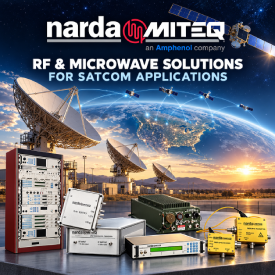
Satellite communications (SATCOM) connect people, networks, and critical systems across the globe, including locations beyond the reach of traditional communications infrastructure. Narda-MITEQ supports commercial, government, and military SATCOM applications with high-performance RF and microwave components, frequency converter systems, amplifiers, fiber optic links, redundant switching equipment, and custom integrated subsystems. From satellite ground stations to spaceborne communications payloads, our technologies help engineers develop reliable satellite communications architectures for demanding operating environments.
With more than 70 years of RF and microwave experience, Narda-MITEQ offers a comprehensive portfolio of SATCOM terrestrial equipment, frequency converter systems, SATCOM amplifiers, and space-qualified components. Our solutions support applications requiring dependable signal reception, frequency translation, amplification, distribution, and subsystem integration.
SATCOM System Classifications: Orbit, Mission Purpose and Architecture
Satellite communications systems can be classified according to their orbital environment, intended mission, and network architecture. These classifications influence coverage, signal propagation delay, communications capacity, terminal design, frequency selection, and RF subsystem requirements.
Orbit classifications include Low Earth Orbit (LEO), Medium Earth Orbit (MEO), Geostationary Earth Orbit (GEO), and Highly Elliptical Orbit (HEO). Mission classifications include broadband connectivity, broadcasting, mobile communications, government and military communications, telemetry, and scientific applications. Architectural classifications address how the space segment, ground stations, user terminals, gateways, and communications payloads exchange information.
Narda-MITEQ provides RF and microwave technologies that can support different portions of these systems, including low noise amplifiers, SATCOM upconverters and downconverters, redundant switchover units, and RF-over-fiber links.
SATCOM Systems Classified by Orbit
Low Earth Orbit (LEO) Satellite Communications
Low Earth Orbit (LEO) satellite communications systems generally operate at altitudes below approximately 2,000 kilometers. LEO constellations are increasingly used for broadband connectivity, remote communications, and specialized commercial and government networks. Their relatively low orbital altitudes can reduce signal propagation delay compared with traditional geostationary satellite communications.
Because LEO satellites move rapidly relative to ground-based users, these networks typically require coordinated satellite tracking, gateway connectivity, and handovers between satellites or ground coverage areas. Ground and spacecraft RF systems must support the electrical and operating requirements of the selected constellation architecture.
Narda-MITEQ offers frequency converter systems, low noise amplifiers, fiber optic links, and converter modules that can be evaluated for applicable LEO ground infrastructure and receiver functions.
For spaceborne applications, Narda-MITEQ's Space Low Noise Amplifiers (SLNAs) are designed for spaceflight missions, including LEO, with frequency coverage from 100 MHz to 40 GHz and multiple gain and screening options.
Medium Earth Orbit (MEO) Satellite Communications
Medium Earth Orbit (MEO) satellites operate between approximately 2,000 kilometers and geostationary orbital altitude. MEO systems are widely associated with navigation satellites and are also used for selected communications constellations that balance coverage, satellite count, and propagation delay.
MEO communications systems may require satellite tracking, precise frequency generation, dependable signal conversion, and RF infrastructure designed around changing satellite positions. The required components depend on the network's frequency bands, payload architecture, terminal design, and service requirements.
Narda-MITEQ offers SATCOM frequency synthesizers, frequency converter systems, SATCOM amplifiers, and redundant switchover equipment for evaluating suitable ground-based RF functions within these architectures.
Geostationary Earth Orbit (GEO) Satellite Communications
Geostationary Earth Orbit (GEO) satellites operate approximately 35,786 kilometers above Earth's equator. From the ground, these spacecraft maintain a nearly fixed apparent position, making GEO systems valuable for fixed satellite communications, television broadcasting, enterprise connectivity, government communications, and other continuous-coverage services.
GEO satellite networks commonly use fixed earth stations and communications hubs containing frequency converters, amplifier systems, signal distribution equipment, and redundant RF paths. High availability, predictable signal performance, and protection against propagation impairments are important design considerations.
Narda-MITEQ's SATCOM terrestrial equipment portfolio includes upconverters and downconverters, SATCOM amplifiers, redundant switchover units, and uplink power control systems for satellite ground infrastructure.
Our uplink power control products are specifically designed for geostationary satellite communications applications and can compensate for changing atmospheric conditions that affect satellite uplink performance.
Highly Elliptical Orbit (HEO) Communications
Highly Elliptical Orbit (HEO) satellites follow elongated orbital paths that create significant variations in altitude and apparent movement. Selected HEO configurations provide extended visibility over high-latitude regions where geostationary satellites may be less suitable for certain communications requirements.
HEO communications ground infrastructure may require tracking antennas, flexible RF conversion, and receiver configurations capable of supporting changing propagation conditions. Narda-MITEQ's frequency converters, amplifier systems, and custom SATCOM products provide potential options for specialized RF requirements, subject to system design and qualification.
SATCOM System Classifications by Mission Purpose
Commercial Broadband and Enterprise Connectivity
Commercial SATCOM networks provide internet access, enterprise connectivity, data transport, and communications services in locations where terrestrial networks may be unavailable or impractical. These networks can use GEO, MEO, LEO, or hybrid satellite architectures based on their required coverage, capacity, and latency.
Ground gateways and communications facilities require dependable frequency translation, signal amplification, and RF distribution. Narda-MITEQ's frequency converter systems, SATCOM amplifiers, and fiber optic links provide relevant product options for these functions.
Broadcasting and Satellite Media Distribution
Satellite broadcasting supports the distribution of television, radio, video, and other media services to large geographic areas. These systems depend on stable uplink transmission, frequency conversion, and signal conditioning to maintain reliable delivery.
Narda-MITEQ offers SATCOM frequency converters, frequency translator systems, and amplitude and group delay equalizers for communications facilities requiring precise RF and intermediate-frequency signal management.
Additional redundant switchover systems can support high-availability configurations where maintaining continuous service is an important operational requirement.
Military and Government Satellite Communications
Military and government SATCOM networks support communications between command facilities, ground vehicles, naval platforms, aircraft, remote installations, and other mission-critical users. These systems may require specialized frequency bands, ruggedized RF equipment, high availability, and custom subsystem integration.
Narda-MITEQ serves both commercial and military satellite communications markets with frequency converters, waveguide amplifiers, amplifier systems, and custom-engineered SATCOM equipment.
Our frequency converter portfolio includes support for C, DBS, Ka, Ku, L, S, and X communication bands, with indoor rack-mounted and ruggedized outdoor antenna-mounted configurations available for applicable products.
Mobility, Maritime and Airborne SATCOM
Mobile satellite communications enable connectivity for aircraft, ships, vehicles, and transportable facilities. Unlike fixed satellite earth stations, mobile terminals must account for platform movement, changing antenna orientation, environmental conditions, and limited installation space.
Narda-MITEQ offers low noise amplifiers, converter modules, and integrated microwave assemblies that can support selected RF signal-chain functions in mobile SATCOM designs. Product suitability depends on the electrical, mechanical, and environmental requirements of the intended platform.
Scientific, Telemetry and Space Mission Communications
Satellite communications also support scientific research, telemetry, spacecraft command and control, Earth observation, and exploration missions. These applications may require sensitive receivers, stable frequency references, specialized RF packaging, and stringent reliability requirements.
Narda-MITEQ's space products portfolio includes spaceborne low noise amplifiers, mixers, oscillators, frequency synthesizers, and passive microwave components.
Our Space Low Noise Amplifiers, Space Mixers, and Space Synthesizers provide specialized technologies for spacecraft RF applications where mission-specific screening and qualification requirements must be considered.
SATCOM Network and Payload Architecture
Ground Segment: Gateways, Teleports and Earth Stations
The ground segment of a satellite communications network includes gateway stations, satellite teleports, antenna systems, monitoring facilities, and associated communications equipment. These facilities provide interfaces between satellites and terrestrial communications networks.
Ground station RF architectures commonly include uplink frequency converters, downlink frequency converters, low noise amplifiers, line amplifiers, signal distribution equipment, and redundancy systems.
Narda-MITEQ's SATCOM terrestrial equipment is particularly well suited to these applications. The product portfolio includes frequency converter systems, amplifier systems, redundant switchover units, and RF-over-fiber links.
Space Segment: Satellite Communications Payloads
The space segment includes the satellites and their onboard communications payloads. These payloads process or relay signals between uplink and downlink coverage areas using RF and microwave electronics suited to the spacecraft's mission and orbital environment.
Narda-MITEQ supports spaceborne applications with space-qualified RF and microwave components, including low noise amplifiers, microwave mixers, and frequency synthesizers. These technologies provide component-level options for applicable space payload signal chains.
Transparent or Bent-Pipe Satellite Payloads
Transparent, or bent-pipe, satellite payloads receive uplink signals, amplify and typically frequency-convert them, and retransmit them toward the intended coverage area. The payload relays the signal without performing the full onboard demodulation and data regeneration used in a regenerative architecture.
These payloads require RF functions such as low noise amplification, frequency conversion, signal filtering, and power distribution. Narda-MITEQ's spaceborne microwave component portfolio includes technologies relevant to these functions, including Space Low Noise Amplifiers and Space Mixers.
Regenerative Satellite Payloads
Regenerative satellite payloads incorporate onboard signal processing to recover and regenerate transmitted information before forwarding it. Depending on the system, this architecture can support onboard switching, routing, and more flexible network management.
Although the digital processing architecture differs from a transparent payload, regenerative communications satellites still require high-performance RF front ends and frequency-generation functions. Narda-MITEQ's space-qualified microwave technologies can be evaluated for those RF functions, while higher-level onboard digital processing is addressed by the overall payload design.
Hub-and-Spoke, Mesh and Hybrid SATCOM Networks
SATCOM networks may use hub-and-spoke, mesh, or hybrid topologies. Hub-and-spoke networks direct communications through central gateways or network hubs, while mesh architectures allow selected users or terminals to communicate through more direct satellite-supported paths. Hybrid networks combine features of both approaches.
The selected network topology influences gateway capacity, terminal design, redundancy requirements, and RF equipment deployment. Narda-MITEQ's frequency converter systems, amplifier systems, and custom SATCOM equipment provide RF subsystem options for these network designs.
Satellite Uplink and Downlink RF Signal Chains
Satellite communications links have distinct uplink and downlink signal paths. An uplink transfers information from an earth station or terminal to a satellite, while a downlink transfers information from a satellite to receiving equipment on the ground or another intended destination.
Uplink chains typically involve frequency conversion and transmission amplification, while downlink chains rely on sensitive low noise reception, frequency conversion, and signal distribution. The exact configuration depends on the operating band and system architecture.
Narda-MITEQ provides SATCOM upconverters and downconverters, SATCOM amplifier products, low noise amplifiers, and waveguide amplifiers for applicable communications applications.
SATCOM Frequency Bands and RF Component Selection
SATCOM systems operate across several RF and microwave frequency bands, including L, S, C, X, Ku, and Ka. Frequency selection influences bandwidth availability, antenna dimensions, propagation characteristics, atmospheric attenuation, and equipment requirements.
Narda-MITEQ manufactures satellite communications frequency converters covering C, DBS, Ka, Ku, L, S, and X bands. Its product line includes fixed-tuned, synthesized tunable, multiband, and discrete frequency converter configurations.
For higher-frequency satellite downlink applications, Narda-MITEQ offers Ka-band SATCOM downlink amplifiers intended for military and commercial ground and aerospace communications systems.
Engineers can evaluate conversion performance, gain, noise figure, phase noise, frequency stability, dynamic range, and environmental requirements when selecting products for their SATCOM RF signal chains.
RF-over-Fiber for Satellite Ground Stations
Large satellite ground stations often place antennas and RF front-end equipment at a distance from centralized communications and monitoring facilities. Fiber optic transport provides a method for moving RF and intermediate-frequency signals between these locations while supporting flexible infrastructure layouts.
Narda-MITEQ's fiber optic links include transmitters, receivers, and related assemblies available in indoor and outdoor configurations. The portfolio includes rack-mounted, card-cage, and specialized configurations, with redundancy and customization options for selected applications.
These technologies provide options for antenna remoting, satellite earth station infrastructure, and communications installations requiring dependable RF signal transport.
High-Availability SATCOM and Redundant RF Architectures
Continuous communications are important for broadcast networks, commercial gateways, government facilities, and mission-critical SATCOM installations. Redundant RF architectures can improve equipment availability by providing backup signal paths and automatic switching capabilities.
Narda-MITEQ offers 1:1, 1:2, and 1:N redundant switchover units designed to improve satellite link availability. Its redundant equipment portfolio also includes low noise and line amplifier systems and redundant configurations for selected frequency converters.
These solutions help engineers develop high-availability ground station configurations while supporting centralized monitoring, control, and failover requirements.
Uplink Power Control and Rain Fade Mitigation
Satellite communications links, particularly those operating at higher microwave frequencies, can experience signal degradation during heavy rainfall and other adverse atmospheric conditions. Maintaining sufficient link performance requires careful consideration of available uplink power and operating margins.
Narda-MITEQ's Uplink Power Control Units are designed for geostationary satellite communications systems. They adjust signal levels at intermediate frequencies based on monitored link conditions to help compensate for atmospheric attenuation.
Combined with appropriate system engineering and redundancy, uplink power control technologies can help improve the consistency of satellite communications during changing environmental conditions.
Custom SATCOM Subsystems and Integrated Microwave Assemblies
Satellite communications programs frequently require specialized RF and microwave solutions beyond standard catalog equipment. Custom subsystem requirements may involve frequency coverage, conversion architecture, environmental performance, physical packaging, signal routing, redundancy, and remote control.
Narda-MITEQ offers custom SATCOM products, converter modules, and integrated microwave assemblies (IMAs) designed around customer requirements.
Our engineering capabilities support modifications to standard equipment as well as new designs for application-specific requirements. Integrating multiple RF functions can help reduce interconnection complexity, conserve equipment space, and simplify implementation within larger satellite communications systems.
Why Choose Narda-MITEQ for SATCOM Applications?
Narda-MITEQ has served the RF, microwave, and satellite communications industries for more than 70 years. Our SATCOM equipment has been deployed in thousands of installations worldwide, supporting commercial and military communications applications.
Our portfolio combines proven satellite ground equipment with specialized RF and microwave components and spaceborne technologies. From individual amplifiers and converters to redundant systems and custom assemblies, customers can evaluate products that address demanding communications requirements.
Whether developing a GEO satellite gateway, a LEO constellation ground station, a government communications facility, or a specialized spacecraft RF subsystem, Narda-MITEQ offers products and engineering experience to help support the required communications signal chain.
Frequently Asked Questions About SATCOM Systems
What is the difference between LEO, MEO and GEO SATCOM?
LEO, MEO, and GEO describe satellite orbital regions. LEO satellites operate at relatively low altitudes and move rapidly across the sky. MEO satellites operate at intermediate altitudes and are used for navigation and selected communications networks. GEO satellites maintain a nearly fixed apparent position above Earth's equator, making them well suited to fixed communications and broadcast coverage.
What RF components are used in satellite ground stations?
Satellite ground stations commonly use frequency upconverters, frequency downconverters, low noise amplifiers, line amplifiers, frequency synthesizers, signal equalizers, redundant switchover units, and RF-over-fiber links. Narda-MITEQ offers products across these categories for satellite communications applications.
What is the difference between a bent-pipe and regenerative satellite?
A bent-pipe satellite relays received communications signals through RF amplification and frequency conversion without fully regenerating the transmitted information onboard. A regenerative satellite includes onboard processing to recover and regenerate information before forwarding it. Both architectures require specialized RF and microwave components.
Does Narda-MITEQ provide equipment for military SATCOM?
Yes. Narda-MITEQ manufactures RF and microwave products for commercial and military SATCOM applications, including frequency converters, amplifiers, waveguide amplifiers, redundancy equipment, and custom communications subsystems. Product selection depends on the operating bands, environmental requirements, and system architecture.
Does Narda-MITEQ offer space-qualified SATCOM components?
Yes. Narda-MITEQ offers space-qualified RF and microwave components, including Space Low Noise Amplifiers, Space Mixers, and Space Synthesizers. Specific screening, qualification, and environmental suitability depend on the product and mission requirements.
Explore Related SATCOM Products
Explore Narda-MITEQ's SATCOM terrestrial equipment, frequency converter systems, SATCOM amplifiers, frequency translator systems, equalizer products, redundant switchover units, uplink power control units, fiber optic links, SATCOM frequency synthesizers, custom SATCOM products, and space-qualified RF components.
Contact Narda-MITEQ for SATCOM Solutions
Are you developing a satellite communications ground station, LEO or MEO gateway, GEO communications facility, military SATCOM terminal, or spaceborne RF subsystem? Narda-MITEQ can help you evaluate standard satellite communications products or discuss application-specific RF and microwave requirements. Contact Narda-MITEQ to connect with our sales and engineering teams.