
Space
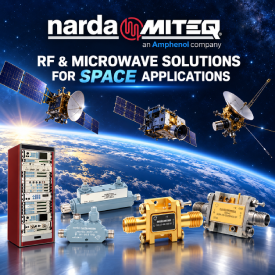
Space missions require RF and microwave technologies capable of delivering reliable performance in some of the most demanding environments imaginable. Narda-MITEQ supports satellite communications, Earth observation, scientific research, spacecraft electronics, and deep-space exploration with high-performance amplifiers, frequency generation products, microwave mixers, passive components, and custom integrated assemblies. From low Earth orbit satellite constellations to interplanetary missions, our spaceborne technologies help engineers address challenging electrical, mechanical, and environmental requirements.
With more than 50 years of spaceflight hardware experience, Narda-MITEQ provides space-qualified RF and microwave components and custom-engineered solutions for aerospace, scientific, commercial, and government programs. Our heritage includes supplying hardware for missions associated with NASA, JPL, JAXA, ESA, and other leading space organizations.
Space System Classifications: Technology, Purpose and Distance
Space systems can be classified according to the technologies they use, the missions they perform, and the distances over which they operate. These factors influence component selection, communications architecture, environmental qualification, and overall RF system design.
Technology classifications include RF receivers, transmit-related electronics, frequency generation and conversion circuits, signal distribution networks, and integrated microwave subsystems. Mission classifications include satellite communications, Earth observation, scientific research, navigation, surveillance, and space exploration. Distance classifications include low Earth orbit (LEO), medium Earth orbit (MEO), geostationary Earth orbit (GEO), cislunar operations, and deep-space missions.
Narda-MITEQ offers specialized space low noise amplifiers, space mixers, space oscillators, space synthesizers, and space passive components for engineers evaluating these applications.
Space Technologies and RF Component Classifications
Low Noise Amplifiers for Spaceborne Receivers
Low noise amplification is essential in spaceborne receiver systems where incoming signals may be extremely weak. Satellite payloads, remote sensing instruments, and scientific spacecraft depend on sensitive RF front ends to preserve signal quality and support accurate downstream processing.
Narda-MITEQ's Space Low Noise Amplifiers (SLNAs) are commercial-off-the-shelf (COTS) solutions designed for spaceflight applications ranging from LEO to deep-space missions. The SLNA family covers frequencies from 100 MHz to 40 GHz, with multiple gain options and screening levels available to meet mission-specific requirements.
These amplifiers incorporate space-oriented design features, including hermetically sealed packaging and radiation-tolerant configurations, providing options for applications where receiver sensitivity, long-term reliability, and environmental performance are critical.
Space Mixers and Frequency Conversion
Frequency conversion enables RF and microwave signals to be translated between frequency bands for reception, processing, and communications. Spaceborne applications require frequency conversion components that maintain stable electrical performance while meeting demanding mission reliability requirements.
Narda-MITEQ offers space-qualified microwave mixers, including hermetically packaged designs with high isolation and low conversion loss. These products can support satellite receiver chains, scientific payload instruments, and specialized spaceborne frequency conversion systems.
Space Oscillators and Frequency Synthesizers
Stable frequency generation is important to spacecraft communications, radar payloads, scientific instruments, and frequency conversion architectures. Oscillators and frequency synthesizers provide reference and local oscillator signals used throughout RF and microwave subsystems.
Narda-MITEQ's space oscillators and space-qualified frequency synthesizers address applications requiring controlled frequency generation, low phase noise, and reliable operation. Our space synthesizer portfolio includes compact phase-locked source designs with frequency coverage from 40 MHz to 15 GHz and various screening options.
Space Directional Couplers and Power Dividers
Passive RF and microwave components support signal distribution, monitoring, measurement, and routing within spaceborne electronic systems. Accurate signal division and coupling are important in multichannel receivers, instrumentation payloads, and communications architectures.
Narda-MITEQ offers space directional couplers for RF signal sampling and power monitoring, along with space power dividers designed for balanced signal distribution. These components provide options for high-reliability satellite payloads and other demanding space applications.
Space Mission Classifications by Purpose
Satellite Communications and Connectivity
Communications satellites provide connectivity between ground stations, users, and other network elements. Satellite communications payloads use RF and microwave electronics for amplification, frequency conversion, signal distribution, and related functions required to process communications signals.
Narda-MITEQ's space products portfolio supports these functions through specialized amplifiers, mixers, frequency sources, and passive components. Our SATCOM terrestrial equipment complements these spaceborne technologies with ground-based frequency conversion and communications products.
Earth Observation and Remote Sensing
Earth observation satellites collect information about the Earth's atmosphere, oceans, land surfaces, and environmental conditions. Remote sensing payloads may use radar, microwave radiometers, and other RF instruments to measure physical characteristics and transmit scientific data to ground stations.
Narda-MITEQ has documented spaceflight heritage associated with Earth observation and scientific programs, including CloudSat, Aquarius, RADARSAT-2, and Global Precipitation Measurement. Our space low noise amplifiers, space mixers, and frequency synthesizers offer relevant building blocks for RF and microwave instrumentation architectures.
Scientific Research and Space Exploration
Scientific spacecraft investigate planetary environments, astronomical phenomena, and physical conditions beyond Earth. These missions often require highly sensitive receiving systems, stable frequency sources, and reliable electronics capable of performing over extended mission durations.
Narda-MITEQ's space heritage includes support for programs such as the Mars Science Laboratory and New Horizons. Our spaceborne RF and microwave technologies provide options for spacecraft instruments, communications electronics, and specialized scientific payload subsystems.
Navigation, Defense and Space Situational Awareness
Space-based navigation, timing, surveillance, and defense-related systems require dependable RF and microwave electronics. These applications may involve precise frequency references, signal reception, microwave distribution, and specialized electronic payloads.
Narda-MITEQ offers space frequency synthesizers, oscillators, space passive components, and custom assemblies that can support selected functions in these architectures. Product qualification and suitability must be evaluated against the requirements of each mission and platform.
Space System Classifications by Distance Range
Low Earth Orbit (LEO): Below Approximately 2,000 km
Low Earth orbit (LEO) includes satellites operating below approximately 2,000 kilometers above Earth's surface. Common LEO applications include Earth observation, remote sensing, scientific research, and satellite communications constellations. These systems often prioritize compact electronics, low power consumption, and reliable operation throughout the satellite's intended service life.
Narda-MITEQ's Space Low Noise Amplifier family is designed to support missions that include LEO applications, offering standardized spaceflight-oriented configurations with multiple gain and screening options. Other relevant component families include space mixers, space synthesizers, and space power dividers.
Medium Earth Orbit (MEO): Approximately 2,000 to 35,786 km
Medium Earth orbit (MEO) generally covers altitudes between approximately 2,000 kilometers and geostationary orbital altitude. Navigation satellite constellations and selected communications systems operate within this region. These missions may require precise frequency generation, dependable signal reception, and electronics designed for the radiation environment encountered along their orbits.
Narda-MITEQ's space oscillators, frequency synthesizers, and low noise amplifiers provide potential component options for MEO mission architectures, subject to application-specific environmental and qualification requirements.
Geostationary Earth Orbit (GEO): Approximately 35,786 km
Geostationary Earth orbit (GEO) is located approximately 35,786 kilometers above Earth's equator. Satellites in this orbit maintain a nearly fixed apparent position relative to the ground, making GEO valuable for telecommunications, broadcasting, weather monitoring, and other continuous-coverage applications.
GEO satellite payloads often require long service life, stable RF performance, and high-reliability components. Narda-MITEQ's space-qualified RF and microwave products include amplifiers, mixers, frequency sources, and passive components that can be evaluated for communications and instrumentation payload requirements.
Highly Elliptical and Specialized Earth Orbits
Some spacecraft operate in highly elliptical or specialized orbits rather than conventional circular LEO, MEO, or GEO configurations. In these missions, the distance between the spacecraft and Earth changes throughout the orbit, affecting communication link conditions, signal strength, and spacecraft environmental exposure.
Narda-MITEQ's spaceborne component portfolio and custom engineering capabilities provide options for developing RF and microwave subsystems around specialized mission requirements.
Cislunar Space and Lunar Missions
Cislunar space encompasses the region associated with Earth-Moon operations, including spacecraft traveling between Earth and the Moon, lunar orbiters, and communications infrastructure supporting lunar exploration. The Moon is approximately 384,400 kilometers from Earth on average, making receiver sensitivity, communication link performance, and reliable operation important design considerations.
Narda-MITEQ's space low noise amplifiers, space mixers, and space synthesizers offer component technologies that can be evaluated for RF systems supporting lunar and cislunar missions.
Deep-Space and Interplanetary Missions
Deep-space missions operate beyond the immediate Earth-orbit environment, including robotic exploration of the Moon, planets, asteroids, and other distant destinations. As communication distances increase, received signal strength decreases and propagation delays become more significant. These missions require carefully engineered communication links, highly sensitive receiving equipment, and reliable onboard electronics.
Narda-MITEQ's Space Low Noise Amplifiers are explicitly designed for spaceflight applications ranging from LEO to deep-space missions. Our broader spaceborne product portfolio includes frequency conversion and signal-generation technologies relevant to demanding spacecraft RF systems.
Space Qualification, Radiation Tolerance and Reliability
Spaceborne electronic components must be evaluated against environmental requirements that can differ significantly from terrestrial applications. Radiation exposure, thermal cycling, launch vibration, vacuum conditions, material compatibility, and long-duration reliability are important considerations in spacecraft hardware selection.
Narda-MITEQ maintains a Space-Qualified Quality Assurance Plan and offers specialized screening and qualification options for space applications. Our Space Low Noise Amplifier family includes configurations with radiation tolerance and screening options extending from NASA EEE-INST-002 Level 3 to MIL-PRF-38534 Class K.
Qualification and screening requirements vary by product, mission, and program. Narda-MITEQ works with customers to evaluate component specifications, testing requirements, packaging, and environmental considerations during product selection and custom development.
Custom Spaceborne RF and Microwave Assemblies
Spacecraft payloads frequently require specialized RF and microwave assemblies that combine multiple functions within compact packages. Integrating amplification, frequency conversion, signal distribution, and related functions can reduce interconnection complexity and help address spacecraft size, weight, and power constraints.
Narda-MITEQ offers integrated microwave assemblies and custom-engineered RF and microwave solutions. With extensive spaceflight experience, our engineering team can work with customers on specialized electrical performance, mechanical packaging, environmental screening, and program-specific requirements.
Why Choose Narda-MITEQ for Space Applications?
Narda-MITEQ has supplied hardware for spaceflight missions for more than 50 years. Our space program heritage includes missions associated with NASA, JPL, JAXA, ESA, and other international organizations, spanning Earth observation, scientific research, and planetary exploration.
Our space product portfolio combines proven RF and microwave design experience with specialized packaging, screening, and custom engineering capabilities. Whether developing a LEO satellite constellation, a GEO communications payload, a scientific instrument, or a deep-space mission, customers can explore components designed to address demanding spaceflight requirements.
Frequently Asked Questions About Space RF Components
What RF and microwave components are used in satellites?
Satellite RF systems may use low noise amplifiers, mixers, frequency synthesizers, oscillators, directional couplers, power dividers, and integrated microwave assemblies. Narda-MITEQ offers specialized space products across these categories, with qualification and screening options depending on the selected product.
What is the difference between LEO, MEO and GEO?
Low Earth orbit (LEO) generally covers altitudes below 2,000 kilometers. Medium Earth orbit (MEO) extends from approximately 2,000 kilometers to geostationary altitude. Geostationary Earth orbit (GEO) is located approximately 35,786 kilometers above Earth's equator and allows satellites to maintain a nearly fixed apparent position relative to locations on the ground.
Does Narda-MITEQ offer components for deep-space missions?
Yes. Narda-MITEQ's Space Low Noise Amplifier family is designed for missions ranging from LEO to deep space. The company also has documented spaceflight hardware heritage associated with scientific and planetary exploration programs. Specific component suitability depends on mission requirements and qualification.
Can Narda-MITEQ provide custom space-qualified RF assemblies?
Narda-MITEQ offers custom RF and microwave design capabilities, supported by extensive spaceflight hardware experience. Customers can discuss specialized assemblies, electrical requirements, environmental screening, and qualification needs with the company's engineering and sales teams.
Explore Narda-MITEQ Space Products
Explore our space-qualified RF and microwave product portfolio, including Space Low Noise Amplifiers, Space Mixers, Space Oscillators, Space Synthesizers, Space Directional Couplers, Space Power Dividers, and Custom RF and Microwave Solutions.
Contact Narda-MITEQ for Space RF and Microwave Solutions
Are you developing a satellite payload, spaceborne scientific instrument, lunar communications system, or deep-space exploration platform? Narda-MITEQ can help you evaluate standard space RF and microwave products or discuss custom-engineered solutions for your mission. Contact Narda-MITEQ to connect with our sales and engineering teams.