
Test & Measurement
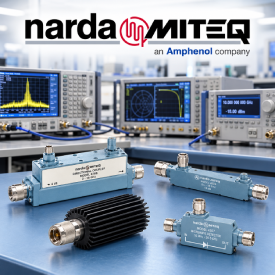
Accurate testing is essential to developing reliable RF and microwave technology. From initial circuit design and prototype evaluation to manufacturing, quality control, and troubleshooting, engineers depend on precise measurements to understand how electronic devices perform. Narda-MITEQ supports these applications with high-performance RF and microwave components, including directional couplers, precision attenuators, detectors, terminations, frequency synthesizers, amplifiers, and custom integrated assemblies.
With more than 70 years of RF and microwave experience, Narda-MITEQ provides technologies used in laboratory test setups, automated test equipment (ATE), manufacturing environments, and specialized measurement systems. Our products help engineers manage RF signal levels, monitor power, distribute signals, generate stable frequencies, and establish reliable connections between measurement instruments and devices under test.
Understanding RF and Microwave Test & Measurement
RF and microwave testing involves measuring the electrical characteristics of components, assemblies, and complete systems operating at radio and microwave frequencies. These measurements help engineers determine whether a device meets its design specifications and performs reliably under expected operating conditions.
Common RF measurements include frequency, output power, gain, insertion loss, return loss, voltage standing wave ratio (VSWR), noise figure, phase noise, harmonic distortion, and intermodulation performance. Each provides valuable information about the behavior of a device under test (DUT).
A typical RF test setup combines specialized measurement instruments with signal conditioning and interconnection components. While analyzers and signal generators perform the primary measurements, components such as directional couplers, fixed attenuators, precision terminations, and RF adapters help establish the signal paths and measurement conditions needed for dependable results.
Essential RF Test and Measurement Instruments
Spectrum Analyzers and RF Signal Analysis
A spectrum analyzer displays the frequency content of an electrical signal and helps engineers identify signal levels, harmonics, spurious emissions, and unwanted interference. Spectrum analysis is commonly used during RF transmitter development, amplifier characterization, oscillator testing, and troubleshooting.
For example, an engineer testing a microwave amplifier may use a spectrum analyzer to examine its output spectrum, measure harmonic levels, or identify unexpected signals. Accurate testing requires controlling the power delivered to the instrument and maintaining a suitable RF connection.
Narda-MITEQ offers directional couplers for sampling RF signals, fixed attenuators for reducing signal levels, and RF terminations for properly loading unused ports or test configurations. These components can support spectrum analysis in laboratory, development, and production environments.
RF Signal Generators and Frequency Sources
Signal generators provide controlled RF signals for testing receivers, amplifiers, mixers, filters, and other microwave components. Engineers use these sources to apply known signals at selected frequencies and power levels, making it possible to evaluate device performance under repeatable conditions.
Signal quality is an important consideration during RF testing. Frequency accuracy, output stability, phase noise, and unwanted spurious signals can influence measurement accuracy and make it more difficult to isolate the behavior of the device under test.
Narda-MITEQ manufactures frequency synthesizers and oscillators for applications requiring stable RF and microwave frequency generation. These technologies can provide local oscillator and reference signal functions in specialized test equipment, frequency conversion assemblies, and custom measurement systems.
For test setups requiring controlled signal amplitude, Narda-MITEQ also offers step attenuators and continuously variable attenuators that allow engineers to adjust RF signal levels during evaluation and characterization.
Vector Network Analyzers and S-Parameter Measurements
A vector network analyzer (VNA) measures how RF energy travels through and reflects from a device. These measurements are expressed as scattering parameters, or S-parameters, and are important when characterizing amplifiers, filters, attenuators, transmission lines, connectors, and other microwave components.
For a two-port device, S11 describes the input reflection coefficient, S21 describes forward transmission, S12 describes reverse transmission, and S22 describes the output reflection coefficient. Engineers use these measurements to evaluate impedance matching, return loss, insertion loss, gain, and other frequency-dependent characteristics.
Measurement accuracy depends on calibration, connector quality, cable stability, and the performance of components in the test path. Narda-MITEQ offers precision RF adapters, low-VSWR terminations, fixed attenuators, and directional couplers that can support microwave network measurements and related test configurations.
RF Power Measurement and Monitoring
RF power measurement is used to evaluate transmitters, amplifiers, signal sources, and complete microwave systems. Depending on the application, engineers may need to measure average power, peak power, or power changes over time.
Power measurement systems can use dedicated power sensors, detectors, directional couplers, and other signal-conditioning components. Selecting the appropriate measurement method depends on frequency coverage, signal modulation, expected power levels, measurement uncertainty, and required response time.
Narda-MITEQ offers RF power monitoring technologies, Schottky detectors, and directional couplers for applications involving signal detection and power monitoring. Directional couplers provide a convenient way to sample a portion of RF power while allowing the main signal path to remain connected.
Critical RF and Microwave Measurements
Gain and Insertion Loss
Gain describes how much a device increases signal power, while insertion loss describes the reduction in signal power caused by a component or signal path. These characteristics are fundamental to evaluating RF amplifiers, filters, cables, connectors, attenuators, and microwave assemblies.
Engineers commonly evaluate gain and insertion loss across the device's operating frequency range to identify variations that could affect system performance. Narda-MITEQ's RF and microwave amplifiers, precision attenuators, and other RF and microwave components can be characterized using calibrated laboratory equipment.
Return Loss, VSWR and Impedance Matching
Impedance matching is important for transferring RF power efficiently between components. Mismatched connections can cause signal reflections, reduce delivered power, and introduce measurement uncertainty.
Return loss and voltage standing wave ratio (VSWR) are commonly used to characterize these reflections. Lower VSWR values generally indicate better impedance matching, while higher return loss values in decibels indicate lower reflected power.
Narda-MITEQ's 50-ohm terminations, precision adapters, and low-VSWR fixed attenuators help engineers manage impedance matching and establish reliable RF test configurations.
Noise Figure and Receiver Sensitivity
Noise figure describes the amount by which a device degrades the signal-to-noise ratio of a signal passing through it. Low noise performance is particularly important in receiver front ends, scientific instrumentation, communications equipment, and radar systems where weak signals must be detected and amplified.
Noise figure testing requires carefully controlled measurement conditions and an understanding of the noise contributions from the test setup. Narda-MITEQ offers low noise amplifiers and RF and microwave amplifier solutions for applications where gain, noise performance, and receiver sensitivity are critical design considerations.
Linearity, Compression and Intermodulation
RF components do not always respond linearly as signal power increases. At elevated signal levels, amplifiers and other active devices may experience gain compression, distortion, or unwanted intermodulation products.
Common measurements include the 1 dB compression point (P1dB), third-order intercept point (IP3), and intermodulation distortion. These characteristics help engineers evaluate whether a device can handle the signal levels and operating conditions expected in the finished system.
Test setups for linearity characterization often require multiple signal sources, signal combining, controlled attenuation, and output spectrum measurements. Narda-MITEQ's power dividers and combiners, step attenuators, and directional couplers can support these measurement architectures.
Phase Noise, Frequency Stability and Spurious Signals
Frequency stability and phase noise influence the performance of oscillators, synthesizers, receivers, and communication systems. Phase noise describes short-term fluctuations in the phase of a signal, while unwanted spurious signals can introduce interference or degrade the performance of sensitive electronic equipment.
Narda-MITEQ designs RF and microwave oscillators and frequency synthesizers with options for demanding phase noise and frequency stability requirements. These products can be incorporated into signal-generation architectures and specialized RF measurement equipment.
RF and Microwave Components for Test Setups
Directional Couplers for Signal Sampling
Directional couplers allow engineers to sample a defined portion of an RF signal without interrupting the primary transmission path. They are commonly used for forward and reflected power measurements, amplifier monitoring, test equipment, and automated measurement systems.
Narda-MITEQ manufactures directional couplers covering applications from DC to 40 GHz, with configurations designed for low insertion loss, broad frequency coverage, and demanding power-handling requirements. Available products include general-purpose couplers, high-power couplers, and specialized measurement configurations.
Precision Attenuators for Signal Level Control
Attenuators reduce RF signal power by a known amount. They are important in test environments where instruments must be protected from excessive input power or where engineers need to establish precise and repeatable signal levels.
Narda-MITEQ offers fixed attenuators, step attenuators, and continuously variable attenuators. These products provide options for laboratory testing, calibration-related setups, signal conditioning, and manufacturing test systems.
Terminations and Dummy Loads
RF terminations absorb signal power and provide a defined impedance for unused ports, transmission lines, and test fixtures. Proper termination is important for reducing unwanted signal reflections and protecting equipment during testing.
Narda-MITEQ offers coaxial and waveguide terminations, including low-power instrument loads and higher-power dummy loads for demanding microwave applications. Engineers can select terminations based on frequency range, VSWR, connector configuration, and power-handling requirements.
Detectors for RF Signal Measurement
RF detectors convert incoming high-frequency signals into output signals that can be measured or monitored by other electronics. These components can be useful for signal presence detection, level monitoring, and related measurement functions.
Narda-MITEQ's Schottky detector portfolio includes zero-bias microwave detectors with frequency coverage from 0.01 to 18 GHz. These products provide options for compact RF detection and monitoring applications.
Adapters, DC Blocks and Bias Tees
Reliable interconnection and signal isolation are important parts of any RF test setup. Even relatively simple components can influence measurement accuracy through insertion loss, impedance mismatch, or unwanted electrical interactions.
Narda-MITEQ offers RF adapters for connecting different connector configurations, DC blocks for preventing direct-current transmission through selected RF paths, and bias tees for combining or separating DC bias and RF signals.
These products can be valuable in laboratory environments where engineers must supply bias voltages to active devices while maintaining suitable RF signal connections.
RF Design, Prototype Testing and Debugging
RF product development requires testing throughout the design process. Engineers begin by evaluating components and circuits individually, then progress to subsystem integration and complete product validation.
During prototype testing, measurements can reveal unexpected gain variations, excessive insertion loss, impedance mismatches, oscillator instability, nonlinear behavior, and unwanted emissions. Isolating these problems requires reliable instrumentation, suitable test fixtures, and components that introduce predictable electrical behavior.
Narda-MITEQ's RF and microwave component portfolio provides building blocks for signal conditioning, controlled attenuation, signal distribution, frequency generation, and monitoring. These technologies can support development teams as they investigate performance issues and refine their designs.
Automated Test Equipment (ATE) and Production Testing
Manufacturing test environments require measurements that are accurate, repeatable, and efficient. Automated test equipment (ATE) helps manufacturers evaluate RF and microwave devices against predefined specifications while reducing manual setup time and improving test consistency.
Production RF test stations may use programmable signal sources, spectrum analyzers, vector network analyzers, switching networks, power measurement equipment, and computer-controlled test sequences. Components such as attenuators, couplers, dividers, and RF switches help distribute and condition signals between measurement instruments and devices under test.
Narda-MITEQ's directional couplers, precision attenuators, power dividers, and integrated microwave assemblies can support the RF signal paths used in automated production test environments.
By combining multiple RF functions into custom assemblies, manufacturers can simplify test fixture integration, reduce interconnection complexity, and develop more consistent signal paths for repetitive measurements.
Over-the-Air (OTA) and Wireless Device Testing
Over-the-air testing evaluates wireless devices using radiated signals rather than relying exclusively on direct cable connections. OTA testing is important for devices with integrated antennas, phased-array technologies, and other systems where antenna performance is closely connected to overall RF behavior.
Depending on the application, OTA testing may require shielded enclosures, anechoic chambers, measurement antennas, signal generators, and receiving instruments. These systems help engineers evaluate radiated power, receiver performance, antenna characteristics, and wireless connectivity.
Narda-MITEQ offers RF and microwave amplifiers, low noise amplifiers, attenuators, and directional couplers that may be used in the associated RF signal-generation and receiving paths. Selection depends on the measurement frequency, power levels, and requirements of the test environment.
Custom RF Test Assemblies and Measurement Subsystems
Some test applications require specialized RF configurations that cannot be implemented efficiently using individual catalog components. Custom assemblies can combine signal routing, amplification, frequency conversion, attenuation, and monitoring functions into more compact packages.
Narda-MITEQ designs and manufactures integrated microwave assemblies (IMAs) and other custom RF and microwave subsystems. These capabilities can support original equipment manufacturers, laboratory equipment developers, and organizations building specialized test and measurement platforms.
Custom engineering provides flexibility when applications require particular frequency ranges, electrical specifications, mechanical layouts, environmental performance, or integration interfaces.
Best Practices for Reliable RF Measurements
Reliable RF testing requires more than accurate instruments. Test setup design, calibration, connector handling, cable quality, environmental conditions, and measurement procedures can all influence results.
Engineers should select components with suitable frequency coverage, insertion loss, VSWR, power-handling capability, and connector specifications. Calibration should account for the measurement reference plane, and test configurations should be documented to improve repeatability between engineering and production environments.
Narda-MITEQ's precision attenuators, low-VSWR terminations, RF adapters, and directional couplers provide options for building controlled and dependable RF signal paths.
Why Choose Narda-MITEQ for Test & Measurement Applications?
Narda-MITEQ brings more than 70 years of experience in RF and microwave component design, manufacturing, and subsystem integration. Our product portfolio includes active and passive components used across commercial, industrial, aerospace, defense, scientific, and test and measurement applications.
For engineers developing measurement equipment or configuring test systems, Narda-MITEQ offers a broad selection of standard RF components along with custom engineering capabilities. Our experience in precision passive components, signal conditioning, frequency generation, and integrated microwave assemblies provides a strong foundation for demanding test applications.
Whether the requirement involves a laboratory evaluation fixture, automated production test station, RF power monitoring circuit, or custom microwave measurement subsystem, Narda-MITEQ offers components and engineering experience to support the application.
Frequently Asked Questions About RF Test & Measurement
What equipment is commonly used for RF testing?
Common RF test instruments include spectrum analyzers, signal generators, vector network analyzers, and RF power meters or sensors. Additional components such as directional couplers, attenuators, terminations, and adapters help establish controlled signal paths and suitable measurement conditions.
What is the difference between a spectrum analyzer and a vector network analyzer?
A spectrum analyzer measures signal power across frequency and is commonly used to examine signal content, harmonics, and spurious emissions. A vector network analyzer measures the magnitude and phase of reflected and transmitted signals, allowing engineers to evaluate S-parameters, impedance matching, insertion loss, and other network characteristics.
Why are directional couplers used in RF testing?
Directional couplers sample a controlled portion of RF power flowing through a signal path. They are used for power monitoring, forward and reflected signal measurement, amplifier testing, and other applications where engineers need to observe RF performance without significantly disturbing the main transmission path.
Why are attenuators important in RF measurement systems?
Attenuators reduce RF signal power by a specified amount. They are used to establish repeatable test levels, prevent excessive power from reaching sensitive instruments, improve certain impedance matching conditions, and evaluate how devices respond to changes in input signal strength.
Does Narda-MITEQ provide components for automated RF testing?
Yes. Narda-MITEQ offers directional couplers, attenuators, detectors, terminations, amplifiers, synthesizers, and other RF components that can support automated test equipment and production measurement systems. Custom integrated microwave assemblies are also available for applications requiring specialized signal routing and subsystem integration.
Explore Related RF Test & Measurement Products
Explore Narda-MITEQ's directional couplers, fixed attenuators, step attenuators, variable attenuators, RF terminations, microwave detectors, RF adapters, DC blocks, bias tees, power dividers, frequency synthesizers, oscillators, RF and microwave amplifiers, and integrated microwave assemblies.
Contact Narda-MITEQ for RF Test & Measurement Solutions
Are you developing a new RF test system, improving a production test process, or building a specialized microwave measurement assembly? Narda-MITEQ can help you identify standard RF components or discuss custom solutions based on your application requirements. Contact Narda-MITEQ to connect with our sales and engineering teams.